 Image 1 of 2
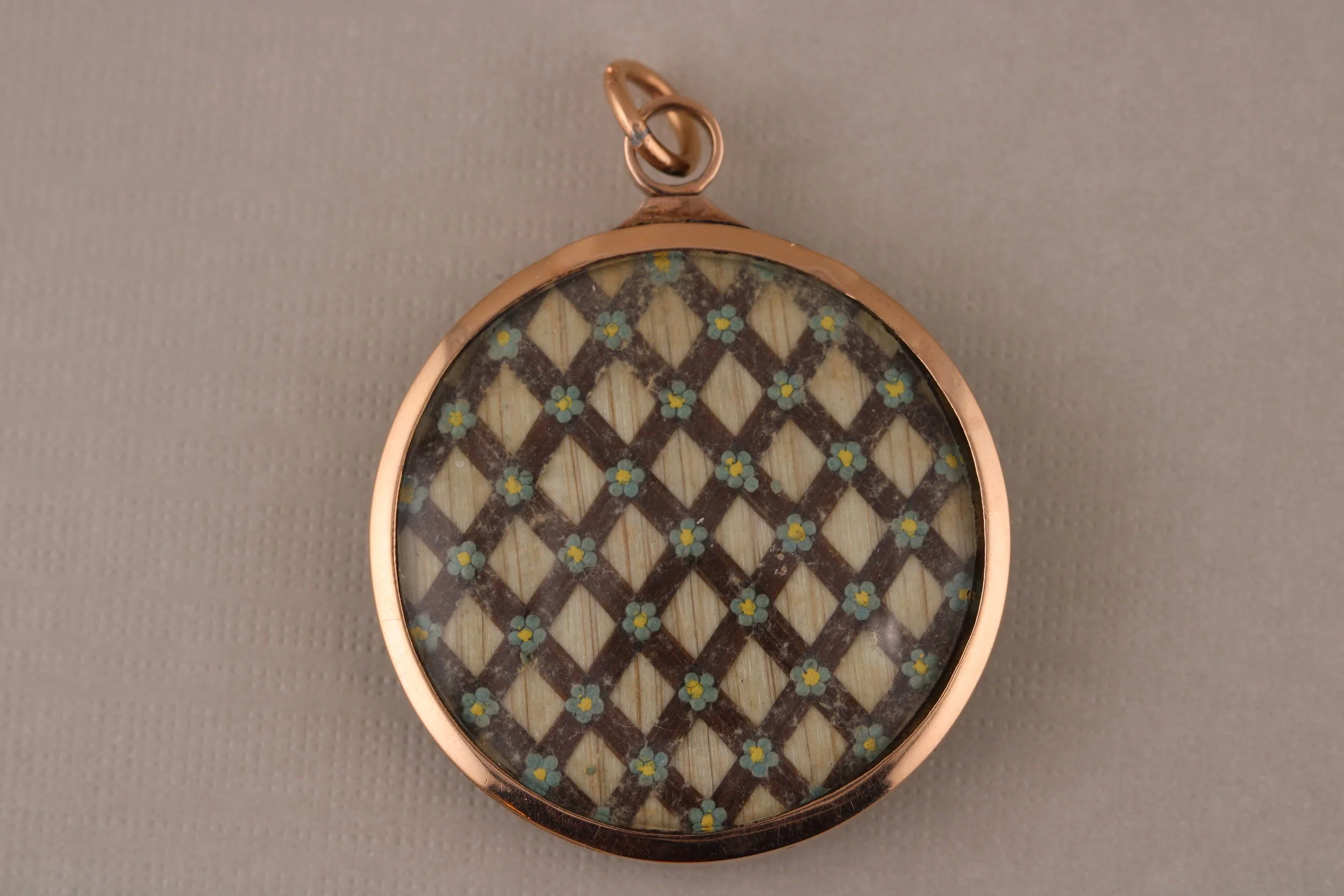 Image 2 of 2
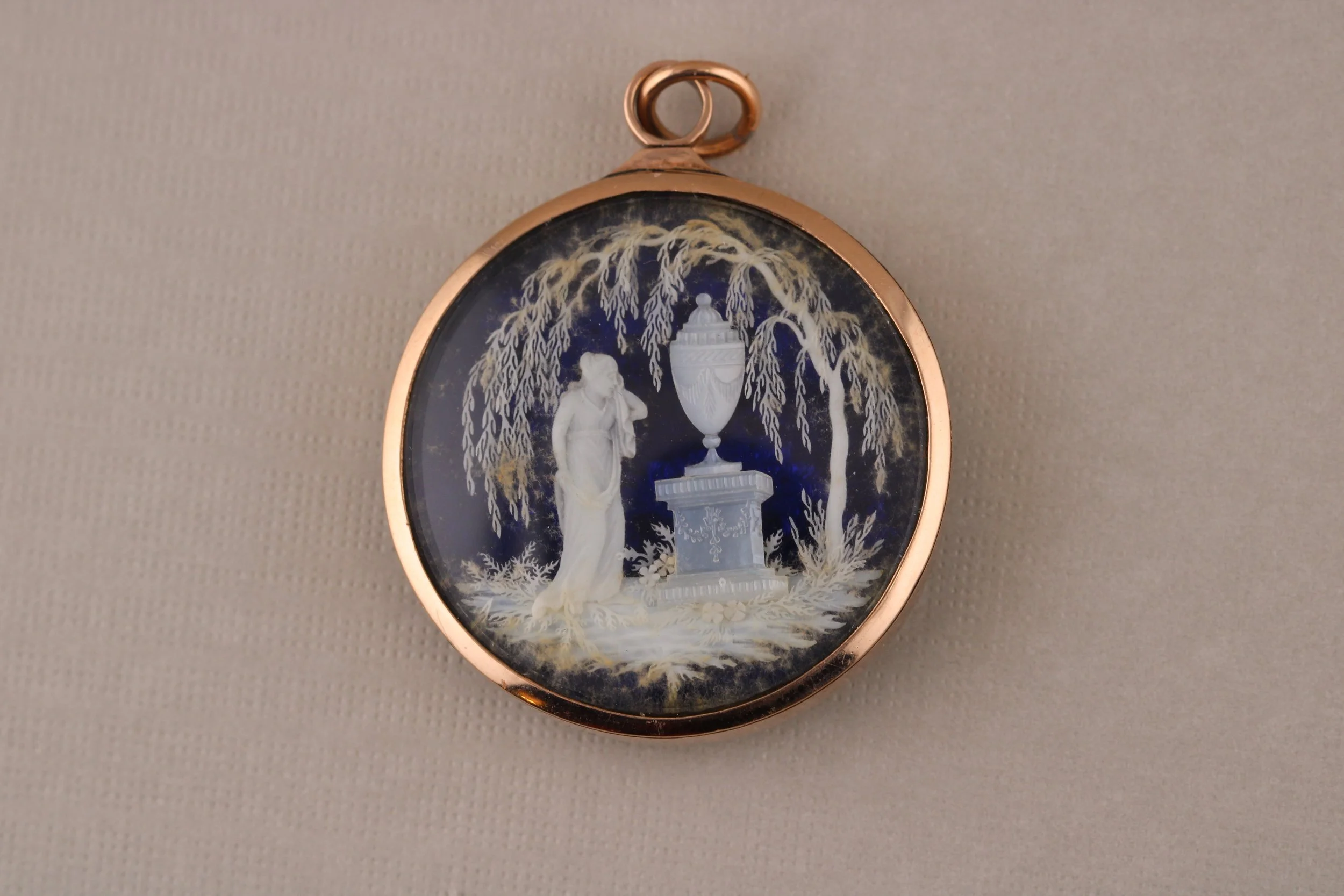
An exceptional and remarkably intricate late 18th-century rose gold mourning pendant, featuring a miniature three-dimensional micro-carved ivory tableau against a cobalt-blue ground.
The miniature depicts a neoclassical female mourner beside a funerary monument beneath a weeping willow, one of the most recognizable symbols of grief and remembrance in late Georgian sentimental jewelry. The extraordinarily delicate ivory work includes individually rendered branches, foliage and landscape details. The central funerary urn and architectural pedestal are fa from mother-of-pearl, providing a subtle contrast in luster and texture to the finely carved ivory elements.
The reverse is also remarkable and preserves the hair of two individuals, intricately arranged into an elaborate lattice pattern. The intersections of the hairwork are decorated with minute three-dimensional blue and yellow forget-me-not flowers, an especially appropriate emblem of remembrance and enduring affection.
The pendant is housed in a rose gold setting and survives as a sophisticated example of the highly specialized European tradition of micro-ivory sentimental and mourning jewelry of the late eighteenth century.
Micro-carving in ivory was an exceptionally specialized art in late eighteenth-century, practiced by a very small number of highly skilled craftsmen. Historical accounts associate the tradition with centers such as Pforzheim and Augsburg, and with artisans including Faber, Ernst Maler, G. Stephany and J. Dresch. While this pendant is unsigned, its workmanship is characteristic of rare German micro-ivory tradition.
This is an unusually elaborate surviving example of late eighteenth-century mourning and sentimental jewelry.
Comparable museum examples include another double-sided micro-ivory and hair pendant from the Royal Collection.
Royal Collection Trust — Pendant with the Cipher of Queen Charlotte
Rijksmuseum — Ring with a Woman Offering at the Altar of Love
Date: Circa 1780–1800
Probable origin: Germany
Materials: Rose gold, micro-carved ivory, mother-of-pearl, cobalt-blue ground, human hair and glass
Diameter: Approximately 2.5 cm (1 inch), excluding bail
Weight: 10.9 grams
An exceptional and remarkably intricate late 18th-century rose gold mourning pendant, featuring a miniature three-dimensional micro-carved ivory tableau against a cobalt-blue ground.
The miniature depicts a neoclassical female mourner beside a funerary monument beneath a weeping willow, one of the most recognizable symbols of grief and remembrance in late Georgian sentimental jewelry. The extraordinarily delicate ivory work includes individually rendered branches, foliage and landscape details. The central funerary urn and architectural pedestal are fa from mother-of-pearl, providing a subtle contrast in luster and texture to the finely carved ivory elements.
The reverse is also remarkable and preserves the hair of two individuals, intricately arranged into an elaborate lattice pattern. The intersections of the hairwork are decorated with minute three-dimensional blue and yellow forget-me-not flowers, an especially appropriate emblem of remembrance and enduring affection.
The pendant is housed in a rose gold setting and survives as a sophisticated example of the highly specialized European tradition of micro-ivory sentimental and mourning jewelry of the late eighteenth century.
Micro-carving in ivory was an exceptionally specialized art in late eighteenth-century, practiced by a very small number of highly skilled craftsmen. Historical accounts associate the tradition with centers such as Pforzheim and Augsburg, and with artisans including Faber, Ernst Maler, G. Stephany and J. Dresch. While this pendant is unsigned, its workmanship is characteristic of rare German micro-ivory tradition.
This is an unusually elaborate surviving example of late eighteenth-century mourning and sentimental jewelry.
Comparable museum examples include another double-sided micro-ivory and hair pendant from the Royal Collection.
Royal Collection Trust — Pendant with the Cipher of Queen Charlotte
Rijksmuseum — Ring with a Woman Offering at the Altar of Love
Date: Circa 1780–1800
Probable origin: Germany
Materials: Rose gold, micro-carved ivory, mother-of-pearl, cobalt-blue ground, human hair and glass
Diameter: Approximately 2.5 cm (1 inch), excluding bail
Weight: 10.9 grams