A Curated World of
Antique Jewelry &
Objets d’Art
Antique Jewelry and Objets d’Art
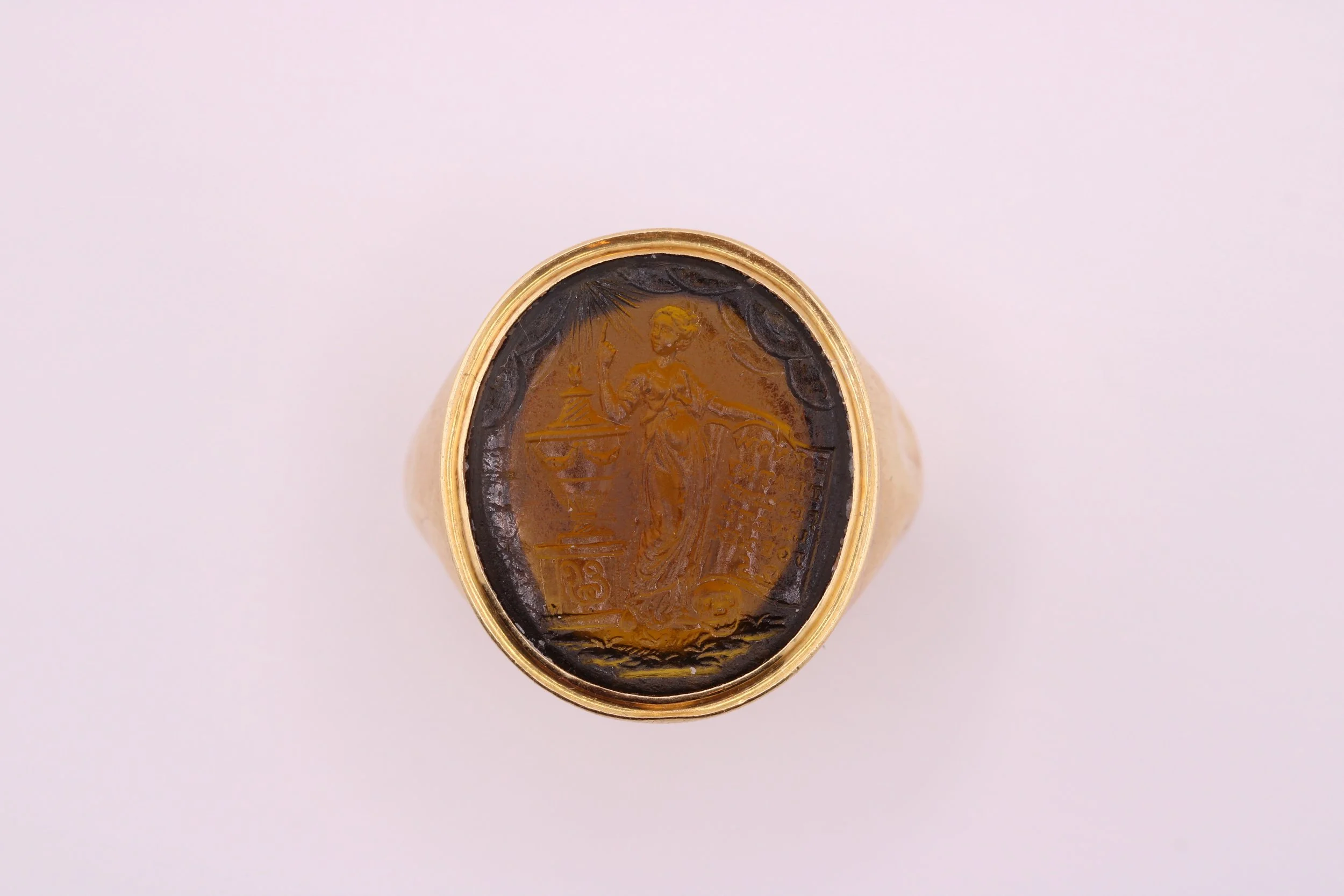
A rare and contemplative jewel of Georgian mourning culture, this ring centers on an 18th‑century amber intaglio depicting Faith, the allegorical figure of steadfast devotion.
Within the Neoclassical intaglio, Faith points up toward a break in the clouds, where rays of light descend from above. Beside her is an open bible inscribed with the words: “I KNOW THAT MY REDEEMER LIVETH — JOB XIX 25”.
At her feet rests a skull, which is not a reminder of mortality, but a sign that death itself has been conquered. Her arm rests on an urn which bears a monogram “E.G.”. Her upward gesture proclaims a triumphant message that faith overcomes death, and the promise of the afterlife prevails.
This very intaglio is recorded in the Beazley Archive at the University of Oxford (Tassie 14805), underscoring its rarity and scholarly significance within the study of engraved gems.
The amber is mounted in a later 18k gold setting, struck with the French eagle head assay mark. Signs of age remain. There are very minor surface abrasions to the intaglio, and some warping to the gold band.
Provenance: Sold at Old Master Sculpture & Works of Art, Sotheby’s London, 05 December 2017, Lot 79.
Gold: 18k
Intaglio: 22 mm
Ring size: 10 ¼ (U ½)
Weight: 9.5g
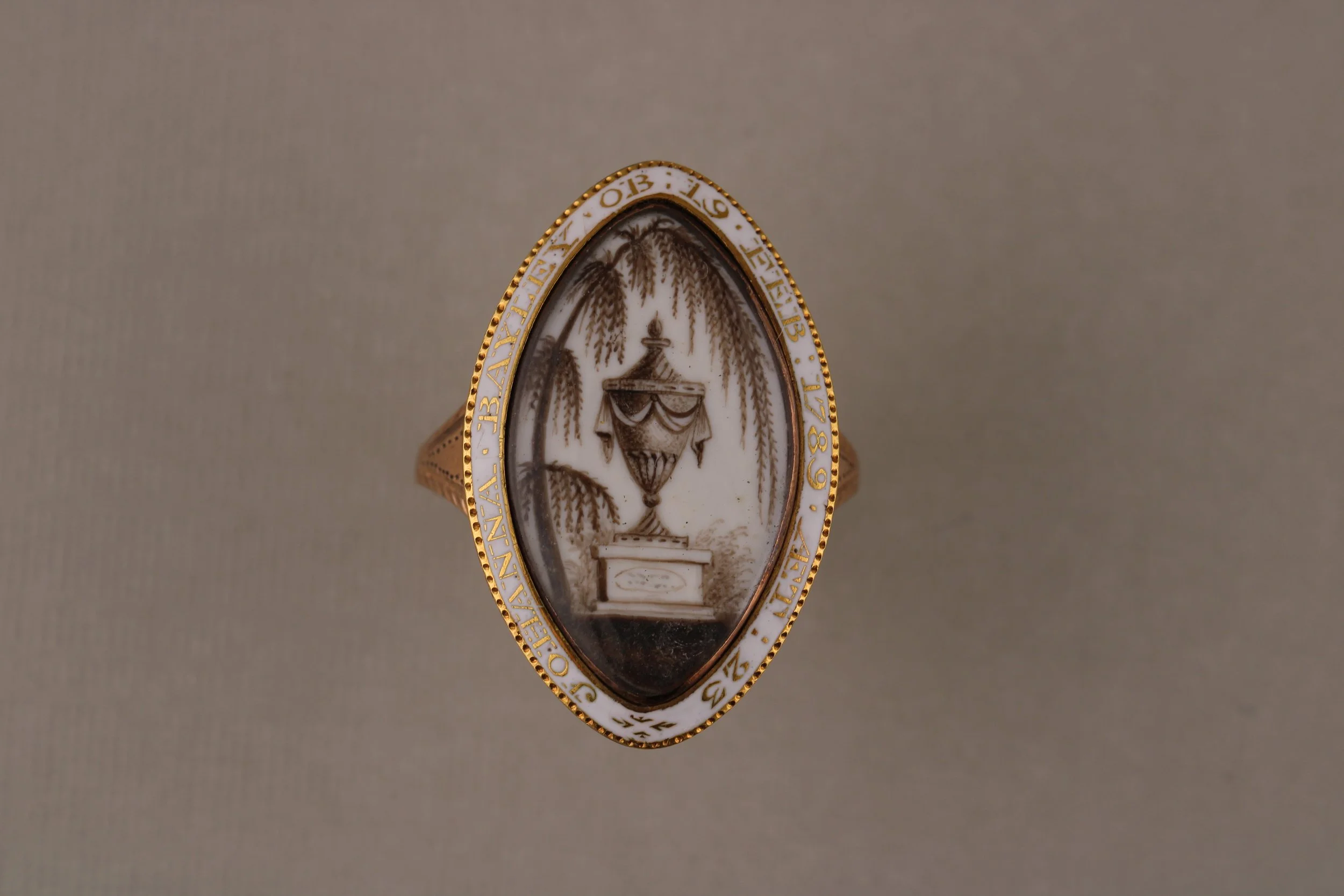
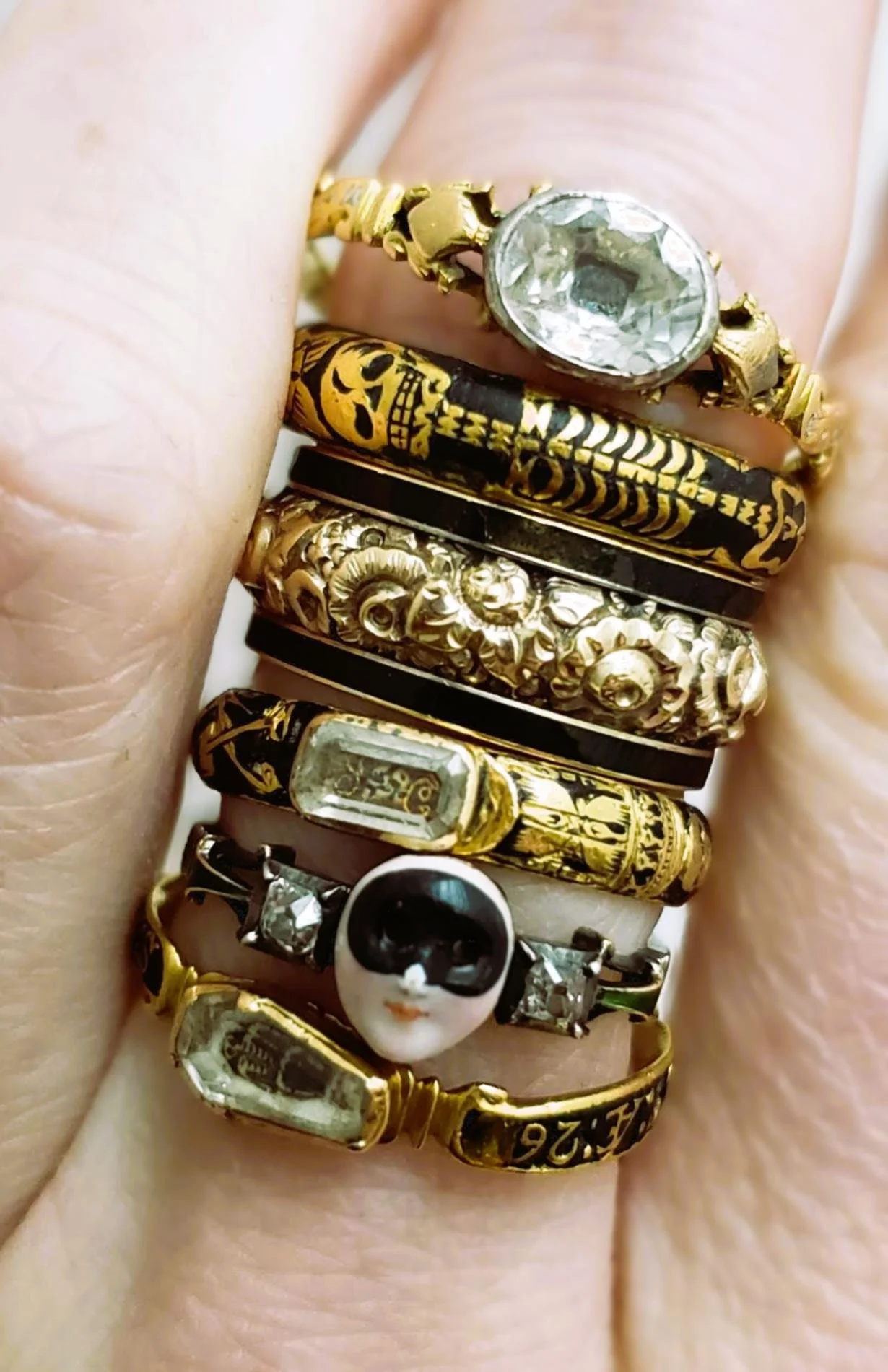
This incredible white mourning ring was made for Johanna Bayley, who died on Februrary 19, 1789, at the age of 23. The inscription on the band says “Johanna Bayley . OB : 19. FEB : 1786 . AET : 23”
The ring is in excellent condition with a white enamel border and an 18k gold bright cut band. The miniaturist painted a scene of a draped urn on a pedestal underneath a weeping willow tree.
The ring is a size US 9.75 UK size T.
Excellent condition
France or Continental Europe, circa 1780–1800
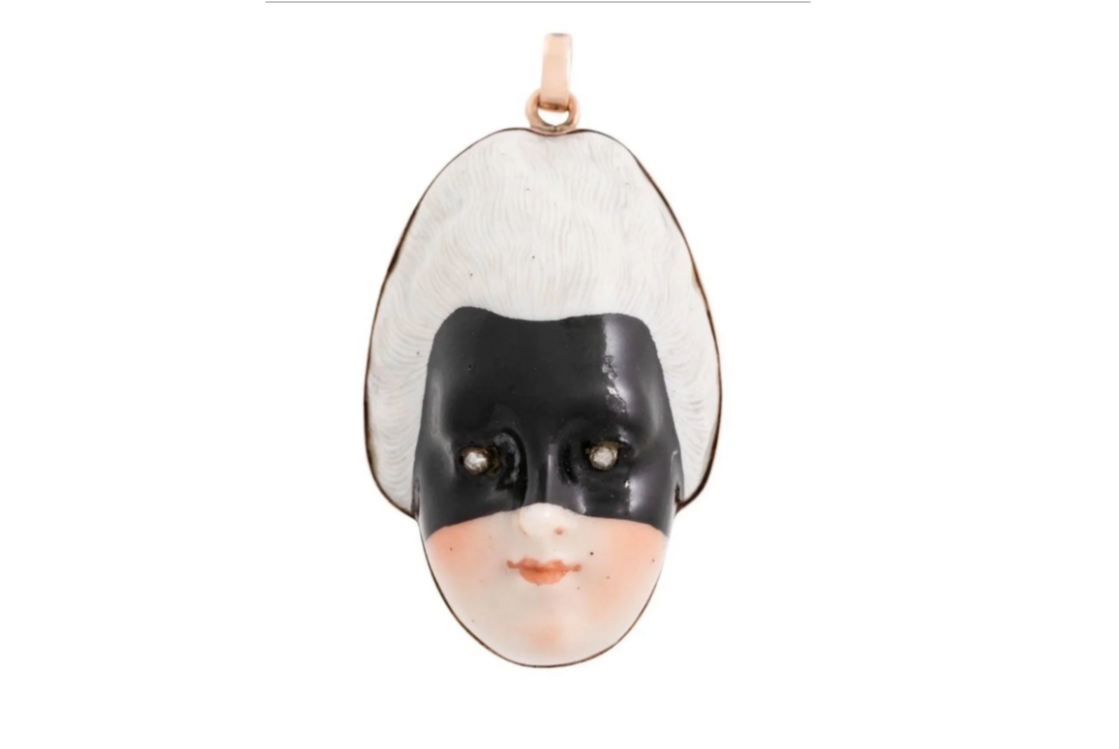
A late 18th‑century masked lady pendant bonbonnière, crafted in porcelain and enamel, mounted in 10k gold, with a beautiful moss agate lid. It reflects the Georgian fascination with masquerade imagery as an object intended to delight the eyes and the senses.
The masked lady’s eyes are set with rose‑cut diamonds. The pendant opens to reveal its original perfumed wadding. The hinge mechanism is in good working order and clicks shut.
The piece retains its original bail. Its intended use was a wearable object.
Details:
• Date: Circa 1780–1800
• Materials: Porcelain and enamel, 10k gold mount
• Lid: Moss agate
• Eyes: Rose‑cut diamonds
• Interior: Original fragrance cotton (perfumed wadding)
• Weight: 20.5 grams
• Length: 5.5 cm
• Bail: Original
Condition: good antique condition, there is a small inscription “H/E/M” on the gold back by the bail. There is some chipping above the left eye which is visible upon eye inspection, agate is in excellent condition, rose cut diamonds are in good condition.
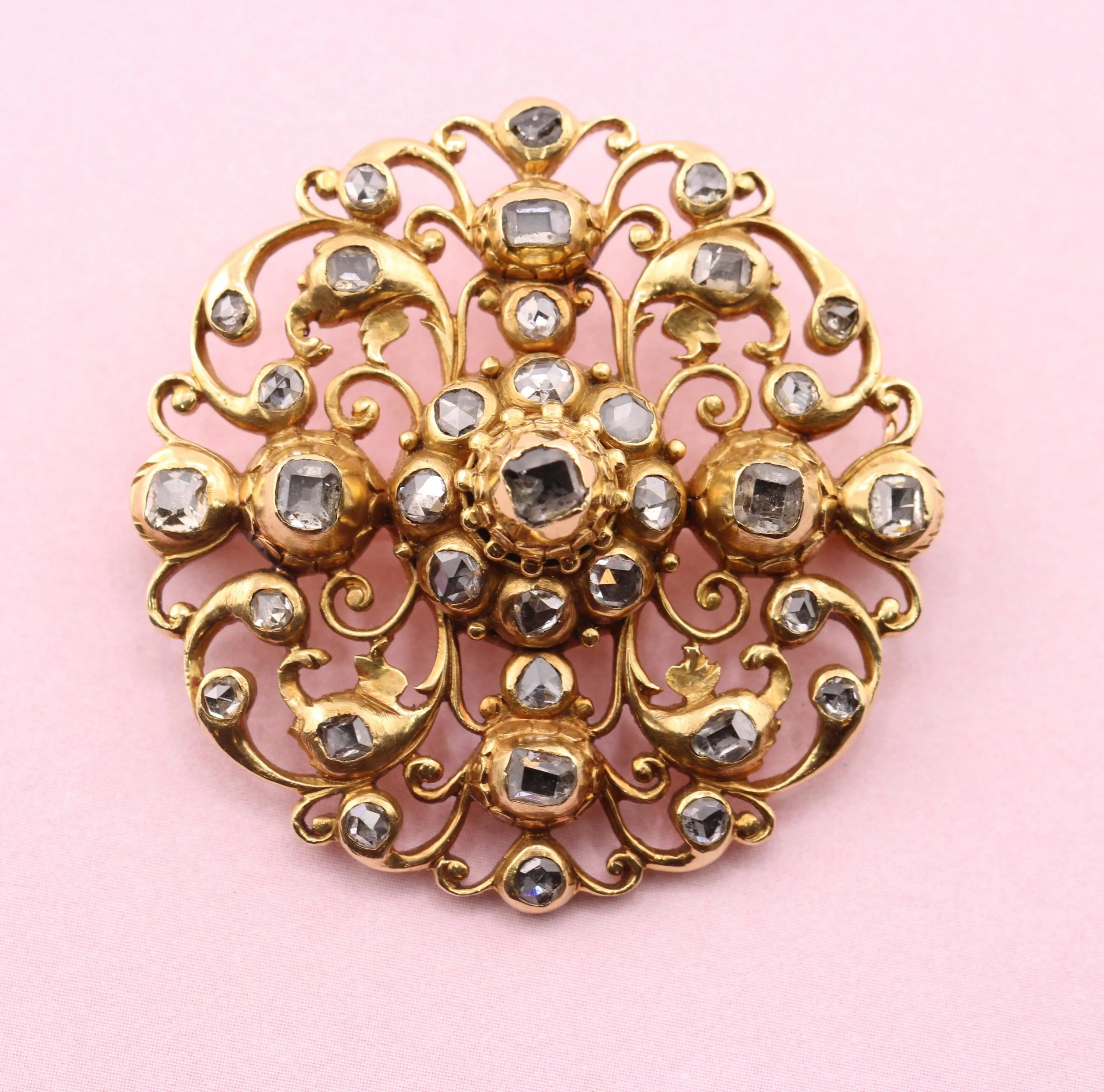
Western European / Iberian
Circa 1680–1700
This exceptional Western European diamond brooch, worn as a dress jewel, dates to the late 17th century, circa 1680–1700, and exemplifies refined late‑Baroque goldsmithing at the threshold of the Rococo. Executed in high‑karat gold (over 18kt), the brooch is set throughout with a mixture of 35 diamonds, comprising late table‑cut and early rose‑cut stones, all mounted in fine rub‑over collets with boxed bezels - hallmarks of elite European workshops of the period.
The brooch is organized as a clustered composition, a format widely favored in late‑Baroque dress jewelry, in which diamonds were arranged in symmetrical, radial groupings around a central focal point. The design is articulated along the cardinal axes, with four principal diamonds placed north, south, east, and west. These stones are distinguished by their classical pie‑crust edging, a deeply scalloped surround characteristic of late‑17th‑century workmanship and strongly associated with Western European goldsmithing traditions of the period, including those of the Iberian Peninsula.
The diamonds display a notably watery, silvery appearance, consistent with early Indian sources that continued to supply Europe well into the late 17th century. The presence of both late table‑cut and early rose‑cut diamonds within the same jewel reflects normal workshop practice around 1700, when earlier cuts remained in circulation and were frequently set alongside rose cuts as diamond‑cutting techniques evolved.
The overall design is animated by lively rocaille scrollwork, with fluid, curling turns that anticipate the Rococo while retaining Baroque symmetry. These elegant gold forms create a sense of movement and visual richness, enhancing the play of light across the diamond surfaces and reinforcing the jewel’s intended impact in candlelit settings.
High carat gold and diamond
3.7cm
center table cut diamond, approximately 3.0mm by 3.14mm
Contact Us
Share your inquiries with us. Whether you’re curious about a piece or seeking something specific, feel free to reach out.